one earbud

I’m finding that many songs I like for the use of stereo imaging are really bad when you can only listen through one ear bud. Stupid stereo thief. Wait, scratch that… car vandal. It’s especially predominant in music from the 1970s. I guess people liked their stereophonics a lot better then.

Trials of Daryl Hunt

Beth, Travis, Michelle and I caught what was apparently the second screening of The Trials of Daryl Hunt tonight, then got to listen to a Q&A session with Daryl himself and one of the film’s producers. The film was a collection of archival footage, interviews, and recent tapings of trial and post-trial events that did a stirring job of telling the story of Daryl and his 20 years of wrongful incarceration.

The story was heartbreaking; 20 years from arrest, conviction and sentencing through numerous appeals to a final absolving of the charges. His community, his friends and his lawyers fought overwhelming ineptitude, bigotry, and ignorance and still managed to free him after more setbacks than most of us could take.

One of the most amazing things I think was that after all the hell he’d been through, the most he asked of anyone was to stop avoiding jury duty and vote. Such simplicity, and sure, he shared what other things we could and should do, but the least we can and should do is fulfill our civil duties. Still, I’m in awe of his ability to return favor to his community.

I really recommend the film.

Chinsulation

I’d like to submit a word for your approval.

Chinsulation
Pronunciation: “chin(t)-s&-‘lA-sh&n
Function: noun
1 : the action of insulating with facial hair
2 : a goatee or other facial hair

Example:
1 : The cold wind didn’t chill Randall’s face because of his chinsulation.

Learning to telemark

I was out having beers with some friends last week when they were describing a recent cross country skiing trip. There was some talk of the danger of hills and it reminded me of my early days of skiing. My family had always been more of a cross-country family, and when we moved to Washington, my dad had started doing some backcountry skiing, and then some telemarking. I was interested in this, partly because it was different than regular alpine, but also because it was more wool than spyder and cowbells. My new friend Ben and his brother Troy were also their own telemark discovery period, so we bonded over the learning experience.

The learning experience was quite hilarious. When there was snow in Yakima we’d ski down to Franklin park with our cross-country gear. There were a couple places in the park where there was enough slope and sometimes enough snow to try and make telemark turns. We were using triple-N bindings and miniscule boots, and our skis lacked edges, so the turns only worked on the smoother, icier surfaces. All-in-all, our technique sucked and were were usually crowded off the terraces by sledders, if we hadn’t scraped off the snow with destructive skidding that we called “turns.” Once when there had been an especially big snow fall, we built a small ramp in the Manfredi’s back yard to practice our turns. It was a respectable amount of snow, and you could just barely complete one turn if you tried.

Eventually we got real backcountry gear – leather boots on sale at Svend’s, REI, or Feathered Friends, and some decent skis with edges and 3-pin bindings. It took about a year of ridiculous attempts at Franklin, up near White Pass, or even on some of the slopes up towards Chinook Pass that we were ready to take on a real ski slope. Our first trips were laughable, but we got better with each trip. Ben and Troy went up more frequently and got better quickly. I picked up what I could from my Dad and his friend Jack, but didn’t really “get” it until a trip to the pass with another fellow student who had a knack for criticizing people into improvement. He actually pointed out the difference between the wide scraping technique, and the real telemark turn.

After this revelation, we started getting pretty good. Once again, more gear was purchased, often more than once per season, but we’d elevated ourselves to a position of respect (or toleration) among downhill skiers and snowboarders alike. The Manfredi’s got really good and could out-ski anyone and really took telemarking to a new level. I never got that good, and was always a little more reserved, but could at least keep up for the most part.

One of the last outings I had with them (and the Hummels) was at Baker the year of the big snow. Before the avalanches that claimed several lives, we skied the arm of Shuksan and couldn’t believe our good fortune. We often hopped lifts without tickets to get up to the top and ventured out for backcountry. The last time we tried this, I got caught and was fined for theft of service. The guys all bought tickets after that, then took up kayaking. I haven’t skied for two seasons now, mostly out of cost, but also time. It’s going to be sad the first time when my thighs give out after an hour or two. At least I’ll be turning and not skidding.
Here comes the science. maybe

My local paper has been reporting on some frightening revelations in the science community this week. First, there has been the attempt by some OSU faculty to delay the publishing of a study that contradicts the administration’s basis for salvage logging. Where to begin? This is one small, specific study that contradicts some previous work by the school, but it’s only the start of a larger area of research that when open to criticism, may help determine future policy. Assuming contradictory work is allowed to be published.

Secondly, NASA’s James Hansen reports that he’s under pressure from the administration to, well, shut up about climate change. Sadly, this is the same type of news we’ve been hearing for several years now. Scientist A from the Department of B finds that their work has been fundamentally changed between the writing and the publishing.

Thirdly, there’s a piece in the paper “Surrounded by Lies” that is mostly about some stupid book whose author pissed off Oprah, but the rest is about the lies told to us by politicians and companies and how we’re ignoring it all.

Web Friendly Street Names

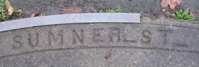
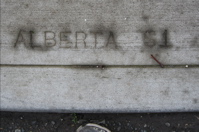
It appears that some of the cement workers in Portland were forward-thinking enough to create web friendly street names, like those in the picture. Using underscores like this is a common technique to avoid problematic URL encoding problems where spaces get converted to %20. How confusing would it have been to figure out your location on a street labeled NE%20SUMNER%20ST%20?
SUMNER_ST_ concrete markings